lunes, 2 de julio de 2018

THE GOOD LIE (AUGUST 2018)


the-good-lie-1The Good Lie is a movie about a group of Sudanese refugees given the chance to resettle in America arrive in Kansas City, Missouri, where their encounter with an employment agency counselor forever changes all of their lives. Nearly 70,000 refugees were resettled across the United States in 2014, many arriving with little more than they could carry. Often, America is thought of solely as a land of opportunity. We overlook hardships that new arrivals to the U.S. may have experienced, focusing instead on the assumed potential before them. America is and has been a safe haven for many people, but in arriving on these shores, they leave behind a life and a home.

Before watching

Reading

Read the following article about Denmark and discuss the incident related to the questions below. Write a short answer and share it here


Danes revive heroic WWII-era practice of smuggling refugees to safety

Line Søgaard (right) sits with the four MedMenneskeSmuglerne members who faced criminal charges for assisting refugees at a press conference after their release. (WNV / Phil Wilmot)
Line Søgaard (right) sits at a press conference with the four MedMenneskeSmuglerne members who faced criminal charges for assisting refugees. (WNV/Phil Wilmot)
About 100 Danes, young and old, stood outside Copenhagen City Court in the chilly seaside winds last Tuesday to show their solidarity with four activists alleged to have illegally assisted refugees in their trek across the waters from Denmark to Sweden.
While only two of the accused are Danish citizens, all are members of MedMenneskeSmuglerne, or “Those who smuggle thy neighbor” — an outgrowth of the more broad-based initiative Welcome to Denmark, which welcomes migrants and refugees into the country.
Last year, over one million migrants and refugees from Syria, Afghanistan, Eritrea and other unstable nations endured the risks of exodus to Denmark and other parts of Europe. Many died during the journey or ended up in refugee camps for prolonged periods. This migration wave correlates directly to the growing xenophobia and shift to the right in many European countries, including Denmark.
“Pretty much all leftist organizations in Europe neglected to consider the refugee influx on their agendas,” said Mimoza Murati, one of the non-Danish activists facing criminal charges that day. “We should have been prepared because we know the political landscape.”
While Danish prosecutors may not have agreed, their case was ultimately dismissed for lack of substantial evidence. The four members of MedMenneskeSmuglerne were met with victorious applause by their Welcome to Denmark cohorts outside the court building.
Providing hospitality for asylum seekers
When Trine Simmel, a young Danish activist from Aarhus, saw the masses of migrants on television pouring across the German border into Denmark’s Jylland peninsula around September 2015, she connected with her friends to figure out what they could do to provide basic needs to the newcomers.
The migrants were being escorted by policemen into Jylland, so the youth initially planned to wait at an overpass, where they could drop care packages full of warm clothes, hygiene products and other essentials. The migrants, however, had become suspicious of being escorted by state authorities and dispersed themselves into the forests, which made tracking them much more difficult.
“The young people residing in Jylland called their parents to convene four or five cars, so shoes and related items could be distributed,” Simmel explained. “When drivers would come across migrants, they would offer the care package and ask them where they wanted to go within Denmark.”
A good number of the refugees decided to go to Copenhagen, just across the sea from Sweden, where some already had family members.
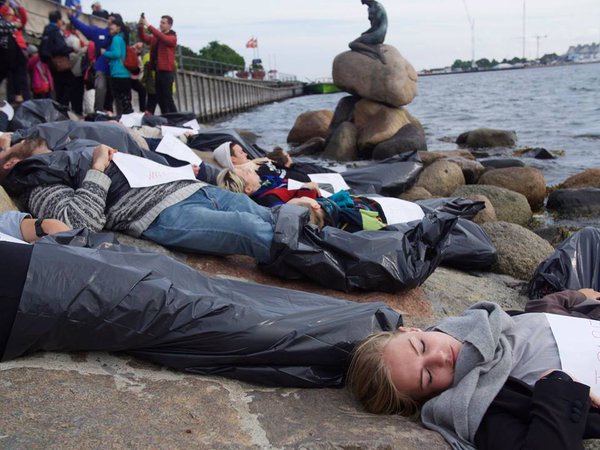
Danish activists stage a scene depicting a dead boat of refugees next to The Little Mermaid Statue in Copenhagen. (Twitter / @FlygtningeInfo)
Danish activists stage a scene depicting a dead boat of refugees next to The Little Mermaid Statue in Copenhagen. (Twitter/@FlygtningeInfo)
“Many apolitical people stepped up to help drive those walking on the railways,” Simmel said. “Many of these people had family backgrounds as immigrants and felt empathetic, but were not usually active in political issues.” An informal hospitality network known as Venligboerne, which includes over 150,000 members across Denmark, helped facilitate the volunteer effort.
Activists like Simmel felt this crisis presented an opportunity to get away from the typical activist duties of meetings and demonstration, and provide a direct service. The influx of refugees tugged at their consciences.
“Just like my grandfather, I had to decide which side of history I wanted to be on,” Simmel said. “Politicians demonized us for posting pictures on Facebook of immigrants being helped, but even [Danes] during World War II were demonized and in violation of the law [for helping Jews].”
Reviving a tradition of refugee smuggling
Denmark was the only country in Europe to reduce the size of its armed forces at the beginning of WWII, yet it was undoubtedly among the most effective in resisting German occupation.
Shortly after an overnight invasion of Denmark on April 9, 1940, 17-year-old Slagelse schoolboy Arne Sejr became frustrated at Danish passivity toward foreign rule. He returned home from school and used his typewriter to print 25 copies of his“Ten Commandments for Danes.” The last of these commandments read, “You shall protect anyone chased by the Germans.”
Danish youth discretely produced fliers of this kind over the course of the German occupation. Groups like the Danish Youth Association under the guidance of theology professor Hal Koch and the Churchill Club in Alborg sabotaged German authorities on a regular basis, sometimes destroying vehicles carrying weapons and munitions.
Christian communities circulated messages against the German occupation through their homilies. This led to the murder of Kaj Munk, who was among the most outspoken clerics advocating for Danish self-rule.
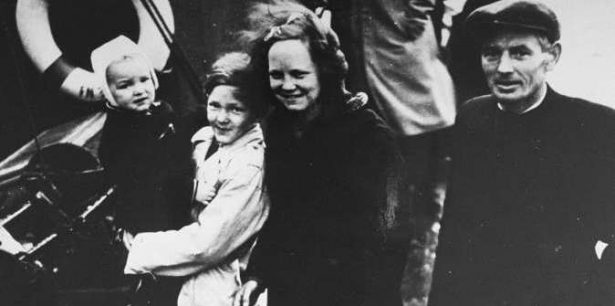
Jewish refugees were ferried out of Denmark aboard Danish fishing boats bound for Sweden. (US Holocaust Museum Memorial / Frihedsmuseet)
Jewish refugees were ferried out of Denmark aboard Danish fishing boats bound for Sweden. (US Holocaust Museum Memorial/Frihedsmuseet)
Among all of the tactics employed, the WWII-era Danes are perhaps most remembered for their effective smuggling of refugee Jews across the border into Sweden. During the course of a few months in 1943, 7,220 Jews — almost the entire Jewish population in Denmark — managed to escape to Sweden with the help of their Danish comrades. Only 472 were captured in early October during raids by the Nazis.
“Early on, we used this history of direct service to refugees as our inspiration,” said Welcome to Denmark organizer Søren Warburg.
Providing a warm bed, an underground route to Sweden, warm clothes and a key to one’s house: These are tactics literally cut from WWII memory and pasted upon today’s context of migration in Europe. Even while Denmark’s present government has intentionally made itself unattractive to asylum seekers, Danes themselves — strengthened by a history of unions and community organizing — are providing the services their elected representatives in the welfare state are refusing to provide.
Reflecting on the history of Danish aid to Jewish refugees, Welcome to Denmark spokesperson Line Søgaard said, “We had a sense that something historical was happening again.” According to her, 500 Danes initially responded to the call to action and formed working groups, focusing both on a political campaign and direct services.
Sailing in solidarity
Since Copenhagen is situated about 20 miles across the Öresund Strait from Malmö, Sweden, members of the sailing community who wanted to help refugees find family members or friends in Sweden decided to take action. In October of 2015, they gathered a list of nearly 20 names of allied boat owners and organized the transport of migrants as a public act of defiance.
“At the beginning, we did not think anyone was going to get prosecuted,” Søgaard said. “There are real human traffickers they could go after, but instead leaders are saying that we are the ones betraying the nation.”
Getting in a boat again is no easy task for refugees who have survived the crossing of the Mediterranean Sea. “Many of the migrants we helped to reach Sweden would send us audio messages once they were relieved to have reached their family members,” Søgaard said. “There was this sense that we were continuing the [WWII] legacy of assisting refugees, which some of our family members had started. We had stuck to our sense of morals and ethics even when the [anti-smuggling] law is wrong.”
Crossing by sea, however, wasn’t the only way to reach Sweden. Calle Vangstrup, one of the other four activists who faced criminal charges, worked with his movement members to provide around-the-clock assistance at Rødby, Padborg and Central stations — three major meeting points where migrants who are usually not conversant in Danish or able to understand the transportation system could depart for Sweden by train.
“There were groups of people who were willing to help within the law and those willing to break the law [prohibiting transportation assistance across the border],” Vangstrup said. “Thankfully, the Swedes are more receptive these days, unlike during WWII when they would often send the smuggled Jews back and put them at risk again.”
Vangstrup believes members of Danish Nazi groups and the populist Danish Peoples’ Party were the ones who saw MedMenneskeSmuglerne on the news and reported them to the police.
“As a socialist and as a human being, I feel I should not enjoy so many rights when the refugees have none,” Vangstrup said.
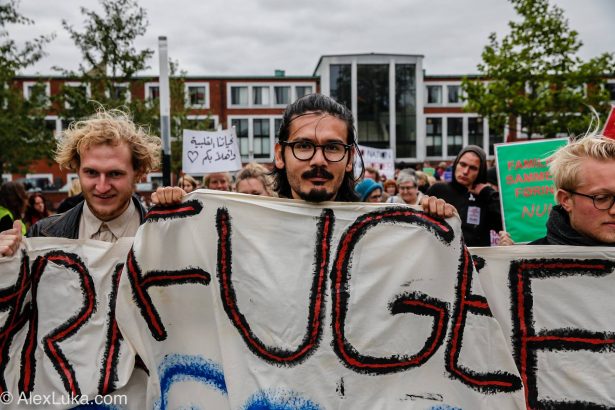
Welcome to Denmark activists march in Aarhus on October 7. (Facebook / Welcome to Denmark)
Welcome to Denmark activists march in Aarhus on October 7. (Facebook / Alex Luka)
Although the police carried out investigations leading to the charges against Vangstrup and his fellow activists last spring, police have not always perpetuated the xenophobia that characterizes the growing right-wing political ideology of Denmark.
During WWII, thousands of police officers were arrested by German authorities. Danish cops had developed a reputation for being unreliable, often deliberately overlooking the acts of sabotage committed by Danish youth against the occupiers.
This kind of humanity among the police resurfaced during the recent migrant influx in Denmark. “Many people were asking police what they could do to help the refugees,” Søgaard said. “The police did not even know how to advise people, so some looked the other way as the transporters continued their work.”
After the four activists accused of human trafficking were relieved of their charges, they spoke at a press conference, encouraging those directly aiding migrants and refugees to continue their work.
“We are not even a radical group,” Søgaard said. “We are just saying the same things that groups like the United Nations are saying [about the migration crisis]. Yet, there is still resistance to our efforts.” At the end of the day, these so-called human traffickers were just helping others in need with a lift to wherever they were going.
“We all have a right to security and a safe place for us and our children,” she continued. “We can’t just close up our borders and live comfortable lives.”

  • Is it ever okay to break the law to do the right thing? If so, how do you determine when that might be okay?
  • What laws or policies do you think are hindering the doing of good in our world today?
  • Is it ever, and if so, at what point is it, appropriate to break those laws?
  • How might you work to overturn those laws?

Research

  1. the-good-lieRead the text below and find out what the situation is in South Sudan today. Discuss it with your partner and share your findings here:
“Following the war portrayed in The Good Lie, South Sudan achieved independence in 2011, a major milestone promising peace to a new generation. However, in December of 2013, a power struggle within the ruling party turned into a brutal armed conflict that continues today – and civilians are paying the highest price as the ones often targeted by violence. Despite agreements from the heads of the warring parties to “end the conflict,” the leaders continue to exploit ethnic differences to fight the civil war. Nearly 1.7 million men, women, and children have been forced to flee their homes as South Sudan continues its slide towards what could be one of the worst man-made famines the world has seen in decades.”

After watching the movie

Discussion

In pairs answer these topics and share your answers here on a Google slides doc or ppt
GO TO THE PPT I HAVE SHARED WITH YOU. (LOOK FOR IT IN YOUR FIGARO EMAIL ACCOUNT


  1. Theo’s Sacrifice Forefathers –
  2. Brotherhood
  3. It Was My Fault
  4. Jeremiah’s Integrity
  5. The Ultimate Good Lie

Write Blogpost

  1.  Discuss the challenges of living in a foreign culture. Include points from your discussions. Write a blog entry exploring the challenges of adapting to an Anglophone culture. 

miércoles, 9 de mayo de 2018

MEXICO-US relationship

The U.S.-Mexico Relationship Has Survived and Thrived Under Trump

Contrary to conventional wisdom, the neighbors are finding ways to make it work.

U.S. President Donald Trump and Mexican President Enrique Peña Nieto during the G-20 Summit in Hamburg, Germany, on July 7, 2017. (Saul Loeb/AFP/Getty Images)
U.S. President Donald Trump and Mexican President Enrique Peña Nieto during the G-20 Summit in Hamburg, Germany, on July 7, 2017. (Saul Loeb/AFP/Getty Images) 
President Donald Trump has incurred criticism for what many have charged is his systematic undermining of the U.S. relationship with Mexico, one of the most important the United States has with any country. During the 2016 U.S. presidential campaign and through his first year in office, Trump repeatedly singled out Mexico for taking unfair advantage of the United States under the North American Free Trade Agreement (NAFTA) and failing to adequately police its side of the U.S.-Mexico border to prevent drugs and criminals from entering the United States and pledged that Mexico will pay for the construction of his proposed border wall.
More recently, tentative plans for Mexican President Enrique Peña Nieto to make his first trip to Washington to meet with Trump were canceled following what the Washington Postreferred to as a “testy” telephone conversation between the two, in which Trump refused Peña Nieto’s request to recognize that Mexico will not pay for the construction of the wall on the U.S.-Mexico border.

There is no bilateral relations have been a roller coaster. The irony, however, is that even as gloom and doom dominates the headlines, the bilateral relationship has not only endured but thrived. Mexican Foreign Minister Luis Videgaray best captured that sentiment last month when he said the relationship was “closer than it was with previous administrations.… That’s a fact of life.”
Equally, during his recent trip to California to examine prototypes of the border wall, Trump had kind words for Peña Nieto, saying that they had a “great relationship” and that he was a very good negotiator on behalf of the Mexican people. Trump added, “Cooperation with Mexico is another crucial element of border security.… We must absolutely build on that cooperation.”
Nor is there any denying the unprecedented senior-level interaction between the Trump and Peña Nieto administrations over the past year. Jared Kushner, Trump’s senior advisor and son-in-law, was just in Mexico City, the latest in a long line of top U.S. officials, including cabinet secretaries, who have engaged with their Mexico counterparts. Similarly, Videgaray has made numerous trips to Washington to confer at the highest levels. These meetings have resulted in deepening bilateral cooperation across the board, including:
NAFTA negotiations. By now, many expected Trump would have withdrawn from NAFTA, a perennial target of his ire on the campaign trail. Instead, the United States, Canada, and Mexico just completed the seventh round of negotiations to modernize the 24-year-old treaty. At a recent White House ceremony where Mexico and Canada were exempted from steel tariffs, the president said, “I have a feeling we’re going to make a deal on NAFTA.”
Negotiators will continue informal talks over the next few weeks before an eighth round, likely in April. The road to NAFTA 2.0 remains challenging, as some of the most contentious issues have yet to be addressed, while negotiators have to work around both countries’ electoral calendars (the Mexican presidential elections in July, the U.S. mid-terms in November). The process may not be very sentimental or for the genteel, but the bottom line is negotiations are continuing.
Security cooperation. No other country in the world directly impacts U.S. homeland security more than Mexico, and U.S. officials say security cooperation with their Mexican counterparts has never been better. Following the most recent round of the U.S.-Mexico Strategic Dialogue on Disrupting Transnational Criminal Organizations, John Sullivan, the U.S. deputy secretary of state, said, “Today, our two countries have one of the most extensive bilateral law enforcement relationships in the world.… We share more information related to migration and border security, enabling us to better identify criminal threats, analyze migration trends, and reduce human smuggling on both sides of the border.”
Videgaray added that U.S.-Mexico security cooperation is not contingent on any other aspect of the bilateral relationship: “Let me be absolutely clear on the matter. Mexico cooperates with the United States when it comes to security because that is in Mexico’s best interest.”
Venezuela and regional cooperation. A key objective of U.S. policy toward Venezuela since President George W. Bush’s administration has been to encourage other Latin American governments to step up in supporting democracy and human rights. Over the past year, Mexico has responded, in doing so jettisoning what is known as the Estrada Doctrine — a pillar of Mexican foreign policy for decades that advocates nonintervention in other country’s affairs. Mexico has not only joined the United States in sanctioning members of the authoritarian government of Nicolás Maduro in Venezuela but has led the diplomatic charge at the Organization of American States and the Lima Group to hold Maduro accountable for his anti-democratic behavior.
Mexico has also continued its support of broader U.S. efforts on stability in Latin America. In June 2017, Mexico co-hosted with the United States a security conference in Miami promoting prosperity and security in Central America.

US-MOROCCO Relationship


The special Morocco-US relationship


The United States (US) over the last century has developed diplomatic relationships with many nations spanning from the Middle East to Europe. Some relationships are even deemed as ‘special’ in the cases of the Anglo-US or Israeli-US relation. However, it is overlooked by many that Morocco and the United States have had diplomatic relations since 1777.Morocco was the first nation to seek diplomatic ties with the United States when they recognised them as an independent sovereign nation on 20th December 1777.1 Formal relations however, begun when Morocco signed a Treaty of Peace and Friendship with the US in 1786. With this treaty the King of Morocco Mohammed III opened Moroccan ports to the US. This treaty is still in place today making it the longest running relationship in Moroccan and US history. Additionally in Tangier, Morocco remains home to the oldest US diplomatic building (the American Legation). From this it can be seen that Morocco in its own way has created a ‘special’ relationship with the US. Though this does raise the question why have Morocco overall had good diplomatic ties with the US for so many years?

Morocco-USA relations since World War One

During the First and Second World Wars Morocco grew closer to the United States. Morocco was aligned with the allies in both wars, and provided support to British and American troops. Additionally, Casablanca hosted many meetings, including the pivotal one in which President Roosevelt offered support for Morocco’s fight for independence against the French.2 Following Moroccan independence in 1956, the United States and Morocco worked together to improve cooperation between the two nations. This was reflected by a somewhat strong US presence in Morocco, especially after the Suez Canal Crisis.3 As Britain retracted to a policy ‘East of Suez’ Communism began to spread within the region. Morocco was a staunch ally against the fight against Communism in the region and this led to stronger relations between Morocco and the US as they both shared similar ideological objectives. The two nations cultivated their relationship in a Cold War World that had grown hotter in Africa. This was achieved through a series of visits of high level government officials from both nations.
After the collapse of the Berlin Wall in 1989 the Morocco-US partnership lost some of its strategic importance, for the US if not for Morocco. In the year and a half that followed, military and economic support remained low. However, it is argued by Professor Yahia Zoubir that the relationship between the two nations grew stronger in the early 1990s. This can be seen as Morocco supported the Gulf War in 1991. The situation was further exacerbated as Algeria became increasingly unstable. Professor Yahia Zoubir observed that this put Morocco “once again in the role of bulwark against extremist, anti-Western forces.”4 In addition to this, Morocco played a role in the US led peace initiatives during the Palestinian Israel conflict. This was during a time in which Morocco attempted to enforce many free market reforms and this too coincided with American economic ideological goals. Furthermore in the aftermath of 9/11 Morocco renewed its obligation as a strong United States ally. Thus the United States initiated dialogues with Morocco via embassies and other governmental officials in regards to Morocco’s role in the war on terror. Since then security cooperation has also greatly increased.

Current relations

The Morocco-US relationship today remains extremely strong, as Morocco collaborate with the United States in a number of areas. This is seen by the Moroccan commitment to encourage free trade, economic development, support for both human rights and democratic reforms, and combating terrorism. The US State Department has stated Morocco is ‘As a stable, comparatively moderate Arab Muslim nation, Morocco is important to U.S. interests in the Middle East as well.’5 Furthermore, United State policy towards Morocco seeks sustainable relations with the US. The two fundamental factors that do sustain this bond are the war on terrorism stance and free trade. King Mohammad VI has also attempted to strengthen this partnership as he has accelerated democratic and economic reforms working closely with American President’s Bill Clinton, George Bush and Barrack Obama. This has led the United States to see Morocco as a model of modernity for the rest of the Middle East to follow.
The United States has recently attempted to combat terrorism by attempting to deny potential safe haven nations. The United States does this by working with allied nations to strengthen national security. Morocco has once again been a model for other nations in the region to follow as they cooperated greatly with the United States on this initiative. Moreover, Morocco has taken a range of methods to fight against terrorism. These methods include the creation of specially trained counterterrorism military units, clamping down on illegal immigration, blocking terrorist access to financial resources, promoting ethnic and religious tolerance and accelerating economic growth through rehabilitating the agricultural sector. Due to Morocco’s attempts to remain a stable nation many such as Matthew Chebatoris of the Jamestown Foundation has described Morocco ‘as a beacon of hope in the often tumultuous North African political environment.’6 Thus it can be seen that through mutual interest and common ideological goals the United States and Morocco have been strong allies.

Moroccan Defence and NATO

The CIA and FBI respectively maintain strong ties to Morocco. Directors of both establishments have visited Morocco in the past years for consultation purposes. In addition to this Morocco is heavily involved with the NATO Mediterranean Dialogue initiative. It has played host as well as participated in NATO military exercises. Morocco has also assisted NATO’s Operation ‘Active endeavour’ in which the Mediterranean Sea is monitored for terrorists. Through the ‘Trans-Sahara Counterterrorism Initiative’ which began in 2005 by the USA. Morocco provides the USA with support to partner countries to prevent terrorism. This is done by strengthening aviation and border security, building support against extremism and encouraging democratic governance.
Due to Morocco’s non-NATO ally status it is eligible for many benefits. For instance Morocco has contributed to research and development programs, and is recipient of the US government loan which guarantees ‘programs for the purchase of military material.’7 The Morocco-US relationship has further developed as Morocco has purchased three billion dollars’ worth of military equipment from the US. This in turn has benefited US companies and promoted US jobs. Purchases have included 24 F-16 aircrafts, 90 AGM-D Maverick air-to-ground missiles and 200 Abrams M1A1 tanks. The Pentagon’s Defence Security Cooperation Agency has also suggested that Morocco has made an immense contribution to the United States foreign policy and national security objectives. This is because Morocco’s has enhanced its capability to support US efforts in the global war on terrorism. This demonstrates that the Morocco-US relationship has developed due to Morocco sharing similar foreign policy objectives with the US. This has in turn had an effect on both military and economic relations between the two nations.

Morocco-US economic relationship

Through development assistance and free trade agreements, the United Sates aims to promote economic growth by liberalizing trade policies. This aim was to an extent reached with Morocco as the two nations signed the US-Morocco Free Trade Agreement (FTA) in 2004. The agreement was meant to increase trade between the two nations and provide both nations with new investment opportunities. Professor Gregory White has argued that the FTA is an example of Morocco’s importance to the United States he stated that ‘the crucial thing to stress with a free trade agreement…is that it constitutes a policy choice on the part of the government.’8 The FTA has strengthened Morocco-US economic ties greatly.
The US has increased aid to Morocco in recent years to support counter terrorism programmes. It also aims to further democratize the nation, building trade capacity and fight poverty. Just in the last fiscal year the Obama administration requested $43.3 million for developing assistance for Morocco. It is suggested in the US Congressional Budget Justification that the US objective in providing development assistance to Morocco include ‘promoting political reform and addressing the challenges of the youth in order to maintain government stability.’9 American economic aid has promoted sustained economic growth. It has aimed to invest in people through improvements in the Moroccan education system, and has, to an extent, promoted democracy and good governance. The aid provided by the United States has also brought various sectors of society into public life, such as the Moroccan youth. As of late Morocco also receives development assistance through the Middle East Partnership Initiative (MEPI) (this is a democracy promotion programme). MEPI’s main objective is to provide ‘small grants to Moroccan NGOs that work to advance peace, participatory democracy and prosperity for Moroccan citizens’.10 Due to this, Moroccan NGOs on average receive $1 million per year for public awareness campaigns, and performing civic duties. This has also led to democratic developments in Morocco including programs to empower women, improvements in the education system, additional legal and judicial reforms, while also creating jobs.
Overall, it is clear that Morocco has enjoyed a strong and lengthy relationship with the United States. The reason for this is mainly due to similar ideological objectives the nations have shared. This can be seen in the promotion of Free Trade and religious freedom. In earlier years they were both united against a common enemy such as Communism. Lastly, the geographical positioning of Morocco has/will always prove to be strategically valuable. This has all allowed the United States to forge a strong bond with Morocco, and is one that has clearly withstood the test of time.
1 Bookin-Weiner, Jerome B. and El Mansour, Mohammed eds. The Atlantic Connection: 200 Years of Moroccan-American Relations 1786-1986 (Edino 1990), p. 20. return to main text
2 Relations in the Modern Era, World War II and Beyond.” United States Diplomatic Mission to Morocco, http://morocco.usembassy.gov/modern.html. return to main text
3 For a more in depth understanding of the Suez Canal Crisis see Anthony Gorst’s The Suez Crisis. return to main text
4 Zoubir, Yahia H. and Karima Benabdallah Gambier. “The United States and North Africa Imbroglio: Balancing Interests in Algeria, Morocco, and the Western Sahara. Mediterranean Politics 10, no. 2 (2005): 181 202, pp. 188,189. return to main text
5 Areiff, Alexis. “Morocco: Current Issues.”Congressional Research Service, June 20, 2012 return to main text
6 Chebatoris, Matthew. “Morocco’s Multi-Pronged Counterterrorism Strategy.” Terrorism Monitor 7, no. 13 (May 2009), http://www.jamestown.org/programs/gta/single/?tx_ttnews[tt_news]=35004&tx_ttnews[backPid]=26&cHash=fc74ab4c69 return to main text
7 Wolf, Jim. “U.S. plans Lockheed F-16 sale to Morocco.” Reuters, December 19, 2007, http://www.reuters.com/article/2007/12/19/morocco-fighters-usa-idUSN1961843520071219 return to main text
8 White, Gregory W. “Free Trade as a Strategic Instrument in the War on Terror?: The 2004 US-Moroccan Free Trade Agreement”. Middle East Journal, 56, no. 4 (Autumn 2005): 597-616, p.598-599, pp. 606-607. return to main text
9 Ibid. return to main text
10 http://mepi.state.gov/mission.html. return to main text
2018
Location: Jerada, Morocco
Event: Media reports that numerous demonstrations and protests continue to occur in Jerada on a regular basis and there have been reports of confrontations between security forces and demonstrators.  These protests are not directed at the U.S. government nor individual Americans. However, even demonstrations intended to be peaceful can turn confrontational and escalate into violence. As a result of the ongoing demonstrations and resulting security operations in the area, the U.S. Mission has recommended its personnel avoid travel to the region and use extreme caution when traveling along R607 and N17 in the vicinity of Jerada until further notice.
Actions to take
  • Avoid the Jerada region
  • Avoid public demonstrations and protests
  • Keep a low profile
  • Be aware of your surroundings

Washington: Morocco Missing an Opportunity in the Trump Administration

 
Washington D.C. – It looks as if Morocco cannot find its bearing in today’s Washington. While the stories about the Kingdom’s gifts to the Clinton Foundation have left a certain image of a Morocco taking sides in the last presidential election. However, the business nature of the Trump administration leaves the door open to a remake of this diplomatic relationship. For that, a reexamination of Morocco’s government and public relations strategies in Washington is overdue.
In fact, an agile Moroccan diplomacy and a “relevant” lobbying firm can easily overcome this small hiccup in an otherwise solid bilateral relationship between the two allies. Despite Mr. Trump’s rhetoric on African nations and his decision to move the U.S. Embassy to Jerusalem, he remains the President of the most influential nation in the world and his government’s positions on matters that Rabat view as crucial stay relevant and significant.
Since there is no one dominant issue that controls President Trump’s foreign policy, Rabat has several tools at its disposal to refocus the Moroccan-American relations on common issues that are still important to the Trump team.
One of the greatest concerns that is shared between the two nations and fits within the Trump admiration’s “America first” slogan is fighting terrorism. The October 2017 attack in Niger that killed 4 American servicemen and has made big news in the United States is one example of an opening that Moroccan officials could utilize to directly access Trump’s White House by passing the State Department.
Currently the U.S. is in dire need of intelligence sources and competent friendly military units who can accompany U.S. special forces during anti-terrorism operations in the great Sahel region.
With the decline of Algeria’s diplomatic and intelligence presence in Mali, Morocco, with its considerable economic and political influence in Africa can fill this void and give the U.S. a leg up in the fight against the Islamic State in the Sahel. Morocco’s successful policy in Africa could make the Kingdom a key component to future strategies of an American administration looking to score victories against terrorism and that enjoy immediate glorification.
Fighting terrorism is only one of the tools in Morocco’s arsenal of assets to get the attention of the Trump team. Now, it is on the Moroccan diplomats and other officials to rebrand the Kingdom’s presence in Washington and sell their “products”. The rewards could be big.
If Rabat succeeds in winning over the blessing of the current administration, Washington could fully endorse Morocco’s local autonomy plan for the Western Sahara. In fact, President Trump could easily recognize the full integration of the Saharan territory into the Kingdom making it an official American positon that would be hard to reverse later.
Since the Moroccan officials’ inability to appreciate the fact that lobbying is not the only way to advance an agenda persists as the biggest hurdle for their diplomacy in Washington, it is time for a new approach as the Kingdom tries to regain its balance in Washington.
In fact, the unpredictability of the current American administration presents an opportunity for the Moroccan diplomats to advance their interests. It is up to them to grab it and use it while it lasts.
The views and opinions expressed in this article are those of the author and do not represent any institution or entity. 

JAPAN-US RELATIONSHIP


How Strong Is the U.S.-Japan Relationship?

The friendship between Washington and Tokyo has come a long way in 70 years, but a rising China could throw a wrench in the works.

aaa162361625

This is a pivotal year in U.S.-Japan relations. As the two nations mark the 70th anniversary of the end of World War II in August, it is a moment for both the American and Japanese publics to reflect on the past — but also, with Japanese Prime Minister Shinzo Abe visiting the United States in late April, to take the temperature of the current bilateral relationship and to consider its future.
As both countries face the rising strategic and economic challenge posed by China, the United States is explicitly rebalancing its international posture toward Asia. Japan has fractious relations with U.S. ally South Korea over unresolved issues involving their mutual history, and with U.S. adversary China over both history and territorial disputes. At the same time, to the consternation of both Seoul and Beijing, Tokyo is debating a more active role in collective regional security. And the United States and Japan are the key economies in an unprecedented effort — known as the Trans-Pacific Partnership — to broaden and deepen trade and investment among Pacific countries that account for more than one-third of the world’s GDP. How the American and Japanese people see these issues may go a long way toward framing the ongoing relationship of these onetime foes and now longtime allies.
Adversaries in World War II, fierce economic competitors in the 1980s and early 1990s, Americans and Japanese nonetheless share a deep mutual respect today.
 Roughly two-thirds of Americans trust Japan either a great deal (26 percent) or a fair amount (42 percent), according to a new Pew Research Center survey. And three-quarters of Japanese share a similar degree of trust of the United States, though their intensity is somewhat less (10 percent a great deal, 65 percent a fair amount).
There is a gender gap in how the two publics see each other. American men (76 percent) are more trusting of Japan than American women (59 percent), just as Japanese men (82 percent) voice greater trust in the United States than do Japanese women (68 percent). But there is no significant partisan difference in how Americans see Japan.
Looking ahead, Americans generally support keeping the U.S. relationship with Japan about where it is, both economically and strategically. When asked whether they would prefer the United States to be closer to Japan, less close, or about as close to Japan as it has been in recent years, 38 percent say closer, 45 percent say about as close, and only 13 percent would like to distance the United States from Japan. There is, however, a generation gap in viewing the future of the relationship: 41 percent of younger Americans would like to see closer ties, but only 27 percent of older Americans would. And there is partisan disagreement on the trajectory of the relationship with Japan: Democrats (41 percent) are more likely than Republicans (30 percent) to support closer ties.
ABOUT THE AUTHOR
Bruce Stokes is director of global economic attitudes at the Pew Research Center.
China looms large in the minds of both Americans and Japanese in their consideration of the U.S.-Japan relationship. Only 30 percent of Americans and just 7 percent of Japanese trust China. One reason Americans may trust China more is that only 16 percent say they have heard a lot about territorial disputes between China and neighboring countries.
Americans are somewhat divided on whether the United States should be focusing more on Japan or on China when it comes to developing strong economic ties. Overall, a slightly larger share of Americans (43 percent) name China as the more important economic partner than Japan (36 percent). About one in eight Americans (12 percent) volunteered an alternative: that it is important to have a strong economic relationship with both.
Americans’ views on the relative importance of economic ties with Japan and China divide along generational, racial, and partisan lines. In particular, young Americans believe it is more important to have a strong economic relationship with China: About six in 10 Americans ages 18 to 29 hold this view. Less than half as many people 65 years of age and older agree. At the same time, twice as many older Americans as younger ones believe a strong economic relationship with Japan is a priority. Republicans are more likely than Democrats to want better relations with Japan. Meanwhile, Democrats are more likely than the GOP to want stronger economic ties with China.
There are no such divisions in Japan on future economic relations with China and the United States. Nearly eight in 10 Japanese (78 percent) say it is more important to have strong economic connections with the United States, while only 10 percent cite China. Young Japanese are more likely than their elders to back a deeper economic relationship with the United States, but the preference for the United States among all age groups, and among all demographic subgroups in Japan, is still overwhelming.
Six in 10 Americans think China’s rise makes relations between the United States and Japan more important. Just 6 percent say it makes ties less important and 29 percent believe it makes no difference. Men (67 percent) are more likely than women (54 percent), whites (67 percent) more than non-whites (48 percent), and Americans 65 years of age and older (65 percent) more likely than those ages 18 to 29 (51 percent) to hold the view that the Japan relationship is now more important because of China’s rise.
At the same time, the American public is divided over whether Japan should play a more active military role in helping to maintain peace and stability in the Asia-Pacific region: 47 percent would like to see Tokyo take a more active role and 43 percent would prefer that Japan limit its role. Americans who trust Japan are more likely to want to see Tokyo play a greater strategic role in the region. And Americans who do not trust China are also more likely to want to see Japan take on more of the military burden in Asia.
Among Japanese, there is little desire for their country to play a greater part in the region’s security. Just over two-thirds (68 percent) want Japan to limit its military activity. Only 23 percent want the country to take on more defense responsibilities. Notably, it is Japanese men (30 percent) more than women (17 percent) who would like to see a more forward-leaning national strategic posture.
Japan and the United States have deeply rooted economic and strategic bonds. But, since both nations are functioning democracies, those ties also depend on the attitudes of the Japanese and American people. Seven decades after a horrific war, and despite serious trade frictions in the past and a new challenge posed by China, Americans and Japanese share a mutual trust and respect that is the glue of the relationship.

NOWADAYS
Time for Japan to Recalibrate?
Image Credit: The White House

Time for Japan to Recalibrate?


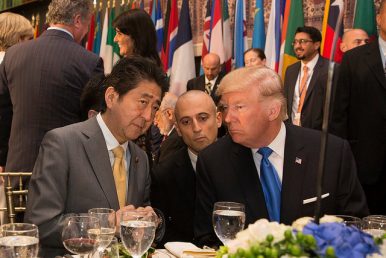
In theory, Japan remains the United States’ staunchest ally in East Asia. The ties have ostensibly been bolstered by a strong personal connection between the leaders of the two countries, cemented by their shared love of golf. But with Prime Minister Shinzo Abe returning to Tokyo after two days in Mar-a-Lago with little to show for his continued efforts to woo U.S. President Donald J. Trump, there is a great deal of talk about what happens next. Amid mounting concerns about Tokyo being marginalized in talks with North Korea on the one hand and worries about U.S. trade strategy on the other, Japan is at a critical juncture in assessing how the United States fits into its own strategy of furthering its own economic and security interests as the regional dynamics rapidly evolve.
The fact that the much-ballyhooed friendship between Abe and Trump has not led to any concrete results has undoubtedly been a tremendous blow for the Japanese premier at a time when he is facing mounting political pressure at home, from scandals over cronyism to sexual harassment scandals involving some of his senior people. Still, Abe going home empty-handed after his latest meeting with Trump is a setback for Japan, and not just for the prime minister. In fact, the 15 months since the president took office have been a tumultuous period for Abe, who is quickly losing ground not just on the domestic front, but on the global stage as well.
So long as Abe seemed to enjoy solid relations with the White House, the position of the world’s third-largest economic power was seemingly solid, in both political and economic terms. The reluctance of the U.S. under Trump to assume its mantle as an Asian power was undoubtedly an opportunity for Tokyo to champion some of the values that had been hallmarks of U.S. commitment in the region, most notably adherence to the rule of law and ensuring open markets. Meanwhile, as the Trump administration quickly decided to withdraw from the Trans-Pacific Partnership, it was Tokyo that played a key role in ensuring that the remaining 11 TPP member countries would continue to move forward and get to an agreement for the Comprehensive and Progressive Trans Pacific Partnership deal, which was completed in March. Japan has been consistent in encouraging the United States to rejoin the TPP, and Trump’s comments that he might well reconsider going back have been welcomed. Given that Trump’s latest musing about the possibility of rejoining came only days before his meeting with Abe, there was a great deal of anticipation about the possibility, which would undoubtedly have given Abe’s regional leadership credentials a boost.

In the nearer term, though, Abe’s prime concern is his inability to get Japan into the group of seven countries that have been temporarily exempted from the steel and aluminum tariffs. Rather than joining the likes of Australia, South Korea, the European Union, Canada, and Mexico, Japan has effectively been placed in the same category as China, with section 232 tariffs imposed on Japanese steel and aluminum exports on the grounds of national security concerns. While the decision is a blow to Japanese steelmakers, the political implications have been even larger, as confidence about how Tokyo is perceived by the current administration and its commitment to broader relations between the two countries on the security as much as the economic fronts have been rattled.Instead, Abe has found himself being told very publicly that the United States remains committed to pursuing bilateral trade agreements instead of multilaterals, with a side note that the U.S. trade deficit with Japan remained a major problem. It seems increasingly likely that Washington will step up efforts to reach a bilateral free trade agreement with Japan, which would undoubtedly pressure Tokyo to give further concessions on key industries including the critical automobile sector.
Amid such wariness about what actions the United States might take against Japan on the trade front, Tokyo has been expanding its outreach within Asia. It has been a driving force in pushing for an Indo-Pacific strategy to corral like-minded nations including the United States across the Asia-Pacific to collaborate on ensuring free and open markets as well as commitment to the rule of law. The more notable development, however, is without doubt a growing willingness between Tokyo and Beijing to identify common objectives. Certainly, the economic dialogue that was held in Tokyo days before the latest Trump-Abe meeting in Florida was groundbreaking, not least because it was the first time in eight years that the foreign ministers of China and Japan were able to engage in a constructive discussion, including talks about advancing the Regional Comprehensive Economic Partnership trade agreement and the possibility of bringing South Korea to the table for trilateral economic talks. As Beijing and Tokyo discuss the possibility of a summit meeting between their leaders, the fact that the two countries have put aside their many source of friction, most notably over territories in the East China Sea, to address areas for potential cooperation is a path that may become ever more attractive as tensions with the United States rise.
For now, though, Abe’s biggest concern will be his own political survival. With little to show from his latest meeting with Trump, his gambit to deliver a win on the diplomatic front may well have backfired.
Shihoko Goto is the Senior Associate for Northeast Asia with the Woodrow Wilson Center’s Asia Program based in Washington DC. 

miércoles, 14 de marzo de 2018

ZIMBABWE: CONTEXT OF WE NEED NEW NAMES


The area of modern-day Zimbabwe has been home to civilization since the 11th century or earlier, due to its fertile location in southeastern Africa between the Zambezi and Limpopo rivers. Mapungubwe, on the bank of the Limpopo, was the first major trading post in the area. This early society was the first to use the name "Zimbabwe," which in the Bantu dialect Shona means "stone houses."
By the 19th century, the Mapungubwe rule had fallen, two kingdoms replaced it in succession, and the Ndebele kingdom rose to power under chief Mzilikazi. During the mid-19th century, some Portuguese travelers occasionally entered the region, but it was not until 1871 that colonists in the form of the British arrived in Zimbabwe in force. The colonial expansion was led by Cecil Rhodes and grew quickly in size between 1871 and the 1890s. In 1892, the administer of the region at the time, Leander Jameson, waged war on the Ndebele kingdom, bringing it to an end. At this point, Zimbabwe became a settlers' colony.
As in America and other British colonies, the settlers soon felt that governmental control should be in their own hands. In 1923, Rhodesia became a self-governing crown colony. Black opposition to colonial rule grew between the 1930s and 1960s, but the colonists retained control. From 1953 - 1963, Britain created the short-lived Central African Federation, made up of Southern Rhodesia (now Zimbabwe), Northern Rhodesia (now Zambia), and Nyasaland (now Malawi). During this ten-year span, the political groups that would shape the independence movement began to form. In 1964, Ian Smith became prime minister and, after petitioning Britain for independent status on the basis of white minority rule, he published the Unilateral Declaration of Independence in 1965.
Over the next ten years, a guerrilla civil war over racial representation took place fueled by support from nearby countries. The Patriotic Front, formed from members of the previously warring ZANU and ZAPU parties, continued to pressure Ian Smith until he made the concession that multi-racial elections would be held in 1979, though members of the Patriotic Front could not participate. As a result, Bishop Abel Muzorewa was elected prime minister of Zimbabwe Rhodesia. However, this governmental shift was not recognized internationally and so civil war continued. In December of 1979, the situation was resolved by Rhodesia returning to the status of a British colony, and the British bought up land from the colonists to redistribute.
In 1980, elections were held again and the ZANU party won. Though tensions continued between the ZANU and ZAPU groups, they politically united to form one party, ZANU-PF, in 1987. Mugabe, the leader elected in 1980, continued being re-elected through the 1980s and 1990s. Tensions between whites and blacks grew throughout the 1990s due to the continued appropriation of some farms owned by white Rhodesians for redistribution. In 2000, Mugabe suddenly increased this campaign, calling upon his supporters to occupy 500 white-owned farms. Around the same time, a new opposition party, the MDC (Movement for Democratic Change), began to form and threaten the chances of another sure ZANU-PF victory.
The period leading up to the next election, in 2002, was unfortunately bloody, with Mugabe's supporters killing over 30 supporters of the MDC. The election was close, with ZANU-PF winning 62 seats and MDC 57. Following the election, Mugabe published a list of 800 large, mostly white-owned farms to be taken by the government and redistributed to the lower classes. Though Mugabe retained power in 2002, the election was looked on by other nations as flawed. The period between 2000 and 2008 under Mugabe's leadership was marked by incredible economic crisis and widespread food shortages. In 2008, elections were held again; the MDC, led by Tsvangirai, who from 2002 - 2008 was repeatedly arrested and accused of treason, defeated Mugabe's ZANU-PF party. However, a run-off election was called for and Mugabe's ZANU-PF party was declared the winner. The U.S. responded with sanctions.
Mugabe and Tsvangirai attempted to share power in 2008, and in 2009 Tsvangirai was sworn in as prime minister. Economic and political involvements with the West have fluctuated in the recent period, and violence continues between the MDC and ZANU-PF parties. A referendum to the constitution passed in 2013 stipulating that a prime minister can only serve two five-year terms. Due to continuing economic instability, the Zimbabwean dollar was formally phased out in 2015, in favor of a multi-currency system.

martes, 10 de octubre de 2017

ACTIVITY FOR THE REAL EXAM

CREATE a Google Drive using your school account and share it with your teacher. Name it SAMPLES OF TEXT TYPES.

USING your booklet AND this blog as a guide, identify the different text types (blog, email, letters, letter to the Editor, speech, article, leaflet, guidelines, debate speech, report, essays) and analyse their STRUCTURE AND STYLE.

Make a summary that is useful for you (of the things YOU need to remember) and look for a SAMPLE of each text type on the Internet. This is very important because you read and select an example of each text type that you can remember when you do your own piece of writing in the exam.

You can use all the web bearing in mind RELIABILITY of sources. For eg: the New York Times, the BBC, e-books, speeches by sources of authority, Greenpeace, www.nomadicmatt.com ("Everyone says I'm running away" and "Why travel makes you awesome" entries), letters, guidelines etc.

Do your best! This is the last leg of the race before the real exam.

For speeches, remember you must use RHETORICAL DEVICES. This is what we mean by style (whether it is formal or informal, whether it is colloquial, you need passive voice, complete or incomplete sentences, etc.)

REMEMBER to consider TAPAR before you write:

T    TEXT TYPE
A    AUTHOR
P    PURPOSE
A   AUDIENCE
R   REGISTER (FORMAL/INFORMAL,SEMIFORMAL)