miércoles, 9 de mayo de 2018

JAPAN-US RELATIONSHIP


How Strong Is the U.S.-Japan Relationship?

The friendship between Washington and Tokyo has come a long way in 70 years, but a rising China could throw a wrench in the works.

aaa162361625

This is a pivotal year in U.S.-Japan relations. As the two nations mark the 70th anniversary of the end of World War II in August, it is a moment for both the American and Japanese publics to reflect on the past — but also, with Japanese Prime Minister Shinzo Abe visiting the United States in late April, to take the temperature of the current bilateral relationship and to consider its future.
As both countries face the rising strategic and economic challenge posed by China, the United States is explicitly rebalancing its international posture toward Asia. Japan has fractious relations with U.S. ally South Korea over unresolved issues involving their mutual history, and with U.S. adversary China over both history and territorial disputes. At the same time, to the consternation of both Seoul and Beijing, Tokyo is debating a more active role in collective regional security. And the United States and Japan are the key economies in an unprecedented effort — known as the Trans-Pacific Partnership — to broaden and deepen trade and investment among Pacific countries that account for more than one-third of the world’s GDP. How the American and Japanese people see these issues may go a long way toward framing the ongoing relationship of these onetime foes and now longtime allies.
Adversaries in World War II, fierce economic competitors in the 1980s and early 1990s, Americans and Japanese nonetheless share a deep mutual respect today.
 Roughly two-thirds of Americans trust Japan either a great deal (26 percent) or a fair amount (42 percent), according to a new Pew Research Center survey. And three-quarters of Japanese share a similar degree of trust of the United States, though their intensity is somewhat less (10 percent a great deal, 65 percent a fair amount).
There is a gender gap in how the two publics see each other. American men (76 percent) are more trusting of Japan than American women (59 percent), just as Japanese men (82 percent) voice greater trust in the United States than do Japanese women (68 percent). But there is no significant partisan difference in how Americans see Japan.
Looking ahead, Americans generally support keeping the U.S. relationship with Japan about where it is, both economically and strategically. When asked whether they would prefer the United States to be closer to Japan, less close, or about as close to Japan as it has been in recent years, 38 percent say closer, 45 percent say about as close, and only 13 percent would like to distance the United States from Japan. There is, however, a generation gap in viewing the future of the relationship: 41 percent of younger Americans would like to see closer ties, but only 27 percent of older Americans would. And there is partisan disagreement on the trajectory of the relationship with Japan: Democrats (41 percent) are more likely than Republicans (30 percent) to support closer ties.
ABOUT THE AUTHOR
Bruce Stokes is director of global economic attitudes at the Pew Research Center.
China looms large in the minds of both Americans and Japanese in their consideration of the U.S.-Japan relationship. Only 30 percent of Americans and just 7 percent of Japanese trust China. One reason Americans may trust China more is that only 16 percent say they have heard a lot about territorial disputes between China and neighboring countries.
Americans are somewhat divided on whether the United States should be focusing more on Japan or on China when it comes to developing strong economic ties. Overall, a slightly larger share of Americans (43 percent) name China as the more important economic partner than Japan (36 percent). About one in eight Americans (12 percent) volunteered an alternative: that it is important to have a strong economic relationship with both.
Americans’ views on the relative importance of economic ties with Japan and China divide along generational, racial, and partisan lines. In particular, young Americans believe it is more important to have a strong economic relationship with China: About six in 10 Americans ages 18 to 29 hold this view. Less than half as many people 65 years of age and older agree. At the same time, twice as many older Americans as younger ones believe a strong economic relationship with Japan is a priority. Republicans are more likely than Democrats to want better relations with Japan. Meanwhile, Democrats are more likely than the GOP to want stronger economic ties with China.
There are no such divisions in Japan on future economic relations with China and the United States. Nearly eight in 10 Japanese (78 percent) say it is more important to have strong economic connections with the United States, while only 10 percent cite China. Young Japanese are more likely than their elders to back a deeper economic relationship with the United States, but the preference for the United States among all age groups, and among all demographic subgroups in Japan, is still overwhelming.
Six in 10 Americans think China’s rise makes relations between the United States and Japan more important. Just 6 percent say it makes ties less important and 29 percent believe it makes no difference. Men (67 percent) are more likely than women (54 percent), whites (67 percent) more than non-whites (48 percent), and Americans 65 years of age and older (65 percent) more likely than those ages 18 to 29 (51 percent) to hold the view that the Japan relationship is now more important because of China’s rise.
At the same time, the American public is divided over whether Japan should play a more active military role in helping to maintain peace and stability in the Asia-Pacific region: 47 percent would like to see Tokyo take a more active role and 43 percent would prefer that Japan limit its role. Americans who trust Japan are more likely to want to see Tokyo play a greater strategic role in the region. And Americans who do not trust China are also more likely to want to see Japan take on more of the military burden in Asia.
Among Japanese, there is little desire for their country to play a greater part in the region’s security. Just over two-thirds (68 percent) want Japan to limit its military activity. Only 23 percent want the country to take on more defense responsibilities. Notably, it is Japanese men (30 percent) more than women (17 percent) who would like to see a more forward-leaning national strategic posture.
Japan and the United States have deeply rooted economic and strategic bonds. But, since both nations are functioning democracies, those ties also depend on the attitudes of the Japanese and American people. Seven decades after a horrific war, and despite serious trade frictions in the past and a new challenge posed by China, Americans and Japanese share a mutual trust and respect that is the glue of the relationship.

NOWADAYS
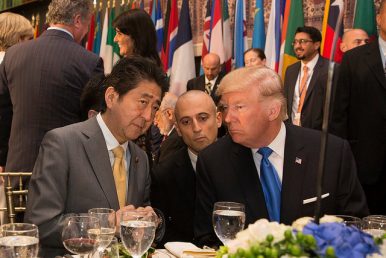
Time for Japan to Recalibrate?
Image Credit: The White House

Time for Japan to Recalibrate?


In theory, Japan remains the United States’ staunchest ally in East Asia. The ties have ostensibly been bolstered by a strong personal connection between the leaders of the two countries, cemented by their shared love of golf. But with Prime Minister Shinzo Abe returning to Tokyo after two days in Mar-a-Lago with little to show for his continued efforts to woo U.S. President Donald J. Trump, there is a great deal of talk about what happens next. Amid mounting concerns about Tokyo being marginalized in talks with North Korea on the one hand and worries about U.S. trade strategy on the other, Japan is at a critical juncture in assessing how the United States fits into its own strategy of furthering its own economic and security interests as the regional dynamics rapidly evolve.
The fact that the much-ballyhooed friendship between Abe and Trump has not led to any concrete results has undoubtedly been a tremendous blow for the Japanese premier at a time when he is facing mounting political pressure at home, from scandals over cronyism to sexual harassment scandals involving some of his senior people. Still, Abe going home empty-handed after his latest meeting with Trump is a setback for Japan, and not just for the prime minister. In fact, the 15 months since the president took office have been a tumultuous period for Abe, who is quickly losing ground not just on the domestic front, but on the global stage as well.
So long as Abe seemed to enjoy solid relations with the White House, the position of the world’s third-largest economic power was seemingly solid, in both political and economic terms. The reluctance of the U.S. under Trump to assume its mantle as an Asian power was undoubtedly an opportunity for Tokyo to champion some of the values that had been hallmarks of U.S. commitment in the region, most notably adherence to the rule of law and ensuring open markets. Meanwhile, as the Trump administration quickly decided to withdraw from the Trans-Pacific Partnership, it was Tokyo that played a key role in ensuring that the remaining 11 TPP member countries would continue to move forward and get to an agreement for the Comprehensive and Progressive Trans Pacific Partnership deal, which was completed in March. Japan has been consistent in encouraging the United States to rejoin the TPP, and Trump’s comments that he might well reconsider going back have been welcomed. Given that Trump’s latest musing about the possibility of rejoining came only days before his meeting with Abe, there was a great deal of anticipation about the possibility, which would undoubtedly have given Abe’s regional leadership credentials a boost.

In the nearer term, though, Abe’s prime concern is his inability to get Japan into the group of seven countries that have been temporarily exempted from the steel and aluminum tariffs. Rather than joining the likes of Australia, South Korea, the European Union, Canada, and Mexico, Japan has effectively been placed in the same category as China, with section 232 tariffs imposed on Japanese steel and aluminum exports on the grounds of national security concerns. While the decision is a blow to Japanese steelmakers, the political implications have been even larger, as confidence about how Tokyo is perceived by the current administration and its commitment to broader relations between the two countries on the security as much as the economic fronts have been rattled.Instead, Abe has found himself being told very publicly that the United States remains committed to pursuing bilateral trade agreements instead of multilaterals, with a side note that the U.S. trade deficit with Japan remained a major problem. It seems increasingly likely that Washington will step up efforts to reach a bilateral free trade agreement with Japan, which would undoubtedly pressure Tokyo to give further concessions on key industries including the critical automobile sector.
Amid such wariness about what actions the United States might take against Japan on the trade front, Tokyo has been expanding its outreach within Asia. It has been a driving force in pushing for an Indo-Pacific strategy to corral like-minded nations including the United States across the Asia-Pacific to collaborate on ensuring free and open markets as well as commitment to the rule of law. The more notable development, however, is without doubt a growing willingness between Tokyo and Beijing to identify common objectives. Certainly, the economic dialogue that was held in Tokyo days before the latest Trump-Abe meeting in Florida was groundbreaking, not least because it was the first time in eight years that the foreign ministers of China and Japan were able to engage in a constructive discussion, including talks about advancing the Regional Comprehensive Economic Partnership trade agreement and the possibility of bringing South Korea to the table for trilateral economic talks. As Beijing and Tokyo discuss the possibility of a summit meeting between their leaders, the fact that the two countries have put aside their many source of friction, most notably over territories in the East China Sea, to address areas for potential cooperation is a path that may become ever more attractive as tensions with the United States rise.
For now, though, Abe’s biggest concern will be his own political survival. With little to show from his latest meeting with Trump, his gambit to deliver a win on the diplomatic front may well have backfired.
Shihoko Goto is the Senior Associate for Northeast Asia with the Woodrow Wilson Center’s Asia Program based in Washington DC. 

miércoles, 14 de marzo de 2018

ZIMBABWE: CONTEXT OF WE NEED NEW NAMES


The area of modern-day Zimbabwe has been home to civilization since the 11th century or earlier, due to its fertile location in southeastern Africa between the Zambezi and Limpopo rivers. Mapungubwe, on the bank of the Limpopo, was the first major trading post in the area. This early society was the first to use the name "Zimbabwe," which in the Bantu dialect Shona means "stone houses."
By the 19th century, the Mapungubwe rule had fallen, two kingdoms replaced it in succession, and the Ndebele kingdom rose to power under chief Mzilikazi. During the mid-19th century, some Portuguese travelers occasionally entered the region, but it was not until 1871 that colonists in the form of the British arrived in Zimbabwe in force. The colonial expansion was led by Cecil Rhodes and grew quickly in size between 1871 and the 1890s. In 1892, the administer of the region at the time, Leander Jameson, waged war on the Ndebele kingdom, bringing it to an end. At this point, Zimbabwe became a settlers' colony.
As in America and other British colonies, the settlers soon felt that governmental control should be in their own hands. In 1923, Rhodesia became a self-governing crown colony. Black opposition to colonial rule grew between the 1930s and 1960s, but the colonists retained control. From 1953 - 1963, Britain created the short-lived Central African Federation, made up of Southern Rhodesia (now Zimbabwe), Northern Rhodesia (now Zambia), and Nyasaland (now Malawi). During this ten-year span, the political groups that would shape the independence movement began to form. In 1964, Ian Smith became prime minister and, after petitioning Britain for independent status on the basis of white minority rule, he published the Unilateral Declaration of Independence in 1965.
Over the next ten years, a guerrilla civil war over racial representation took place fueled by support from nearby countries. The Patriotic Front, formed from members of the previously warring ZANU and ZAPU parties, continued to pressure Ian Smith until he made the concession that multi-racial elections would be held in 1979, though members of the Patriotic Front could not participate. As a result, Bishop Abel Muzorewa was elected prime minister of Zimbabwe Rhodesia. However, this governmental shift was not recognized internationally and so civil war continued. In December of 1979, the situation was resolved by Rhodesia returning to the status of a British colony, and the British bought up land from the colonists to redistribute.
In 1980, elections were held again and the ZANU party won. Though tensions continued between the ZANU and ZAPU groups, they politically united to form one party, ZANU-PF, in 1987. Mugabe, the leader elected in 1980, continued being re-elected through the 1980s and 1990s. Tensions between whites and blacks grew throughout the 1990s due to the continued appropriation of some farms owned by white Rhodesians for redistribution. In 2000, Mugabe suddenly increased this campaign, calling upon his supporters to occupy 500 white-owned farms. Around the same time, a new opposition party, the MDC (Movement for Democratic Change), began to form and threaten the chances of another sure ZANU-PF victory.
The period leading up to the next election, in 2002, was unfortunately bloody, with Mugabe's supporters killing over 30 supporters of the MDC. The election was close, with ZANU-PF winning 62 seats and MDC 57. Following the election, Mugabe published a list of 800 large, mostly white-owned farms to be taken by the government and redistributed to the lower classes. Though Mugabe retained power in 2002, the election was looked on by other nations as flawed. The period between 2000 and 2008 under Mugabe's leadership was marked by incredible economic crisis and widespread food shortages. In 2008, elections were held again; the MDC, led by Tsvangirai, who from 2002 - 2008 was repeatedly arrested and accused of treason, defeated Mugabe's ZANU-PF party. However, a run-off election was called for and Mugabe's ZANU-PF party was declared the winner. The U.S. responded with sanctions.
Mugabe and Tsvangirai attempted to share power in 2008, and in 2009 Tsvangirai was sworn in as prime minister. Economic and political involvements with the West have fluctuated in the recent period, and violence continues between the MDC and ZANU-PF parties. A referendum to the constitution passed in 2013 stipulating that a prime minister can only serve two five-year terms. Due to continuing economic instability, the Zimbabwean dollar was formally phased out in 2015, in favor of a multi-currency system.

martes, 10 de octubre de 2017

ACTIVITY FOR THE REAL EXAM

CREATE a Google Drive using your school account and share it with your teacher. Name it SAMPLES OF TEXT TYPES.

USING your booklet AND this blog as a guide, identify the different text types (blog, email, letters, letter to the Editor, speech, article, leaflet, guidelines, debate speech, report, essays) and analyse their STRUCTURE AND STYLE.

Make a summary that is useful for you (of the things YOU need to remember) and look for a SAMPLE of each text type on the Internet. This is very important because you read and select an example of each text type that you can remember when you do your own piece of writing in the exam.

You can use all the web bearing in mind RELIABILITY of sources. For eg: the New York Times, the BBC, e-books, speeches by sources of authority, Greenpeace, www.nomadicmatt.com ("Everyone says I'm running away" and "Why travel makes you awesome" entries), letters, guidelines etc.

Do your best! This is the last leg of the race before the real exam.

For speeches, remember you must use RHETORICAL DEVICES. This is what we mean by style (whether it is formal or informal, whether it is colloquial, you need passive voice, complete or incomplete sentences, etc.)

REMEMBER to consider TAPAR before you write:

T    TEXT TYPE
A    AUTHOR
P    PURPOSE
A   AUDIENCE
R   REGISTER (FORMAL/INFORMAL,SEMIFORMAL)

lunes, 14 de agosto de 2017

sample

assessment comments
PAPER 2
SECTION A

OPTION: CULTURAL DIVERSITY

You are taking part in a class debate on the motion: "When people move to another country and wish to adapt well, they should adopt its culture and forget their own". Write the text of the debate's opening speech, either agreeing or disagreeing with this motion.

Persuasive Speech
Following the writing of a resolution, students should prepare speeches. Speeches must be planned in order to be effective. Speaking “off the cuff” is necessary, especially during points of information, but the ultimate aim is for all participants in the debate to speak freely using only their notes to guide them.
It is recommended to write out a speech in full ahead of time and put it to memory but not recommended to read a speech word for word.
The object of a speech is to persuade and even convince others and not merely to state an opinion. In some cases, a nation’s policy may place a student in a position where he must defend the indefensible and cannot be expected to persuade a majority to support him. In preparing speeches, students must be aware not only of their strengths and weaknesses, but also be aware of the points to be made by others. It is advisable to list arguments and counter-arguments so students will be in a position to defend their views as well as make proposals.
Remember: a speech is heard only once and, therefore, needs to leave a strong impression. The audience will remember the important parts of a speech that is short, clear and well structured than if they have to listen to a long, confusing, and rambling one. The key elements to an effective speech include the following:
  1. The most important points are arranged in ascending order with the final point a climax.
  2. Numbering the points is helpful to the speaker in delivering the speech and to the audience in remembering it.
  3. Use a key word or phrase for each argument and repeat the main points before yielding the floor.

The advanced speaker has taken the next steps in preparing his techniques in delivery. Besides building repetitions, using catch phrases and rhetorical pauses, he has worked out his stance (firm, dogmatic, ironic, conciliatory, etc.), the image he wants to project (idealistic, revolutionary, moderate, etc.), and the appropriate level of language needed for the role he is assuming. The MUN Director can help in the selection of appropriate terminology, phraseology and vocabulary in this aspect of speech making in the classroom.
Speakers should deliver their speeches in a clear, loud voice. Every speech should have an obvious beginning, e.g. “Madame Chairwoman, ladies and gentlemen, the delegate is in favor of this resolution because...,” followed by arguments that are to the point, and an obvious ending, e.g. “Therefore, I urge the House to vote in favor of this resolution. I will now yield to points of information.” Points of information must be phrased in the form of a question, but that does not imply that they are used to elicit information from the speaker. In many cases, they are used rhetorically in order to express an opinion when one does not have the floor or to support or disconcert the speaker who does have the floor, e.g. “Does the speaker not agree that the recent strike against unarmed civilians in Iraq can only be regarded as murder?”
The speaker who has the floor should not allow himself to be put off by points of information. He can, however, take the opportunity to reply to the question in any way he chooses, either re-emphasizing his points earlier or using the question as a springboard to launch into another argument. Points of information should never be answered by a simple “yes” or “no” which would be a wasted opportunity. It is during this stage of answering points of information that the debate is the liveliest, so students should be encouraged to answer points which arise and not simply yield the floor after delivering their prepared speech.
Opening Speech
Opening speeches take about one minute to present. Its purpose is to introduce the country and to give a very brief introduction to the issue discussed in their resolution as well as the country’s perspective regarding other issues that will be debated within the caucus.

Sample Persuasive Speech
Good morning delegates of the house and chairperson. My name is -------- and along with ------, I represent -----------. Today our delegation is here to discuss one of the most aggravating issues in the world. It is a great concern to our people, and we are sure that it is a great concern to the entire world as well – we are here to discuss the HIV virus, most commonly known as AIDS.
As all of you are aware, ----------- suffers from a tremendous lack of health care, which accelerates the population’s death rate. The HIV/AIDS is affecting 1.1 million people in the country. This disease is most commonly transmitted by women that are raped by members of armed groups in eastern -------.  Survivors of rape are frequently abandoned by their families and communities; therefore they are forced to leave their homes and are left in poverty.
Women are three times as likely to be living with HIV/AIDS as young man, and within the next ten years, more than half of the population will be threatened by it. It will also have a catastrophic future affect on the health of the country.
            Due to its history of so many civil wars, diseases and death rates are always increasing in -----------. The widespread destruction of homes and hospitals has left children without families and many people with sicknesses and injuries. Because of the country’s poverty, state health facilities offer no treatment for HIV/AIDS other than voluntary tests and council.
            The HIV/AIDS virus acts as a significant brake on the economic growth and development of the country, since the people affected are forced to leave their jobs.
            The -------- is so devastated and it needs so much more than it already has to become a society where health and well being is a priority.
            For this reason we urge all delegates of the house to vote in favor of our resolution.
            Thank you for your attention.


Sample Opening Speech
            Good Morning Chair People, delegates of the house. My name is ------ and along with ----------, I represent----------. We are here today, in another United Nations conference, such as the one that created our country.
            We hope that the present delegations will engage only to fruitful debates, in order to make this conference productive and relevant. Let’s all take wise decisions after considering every resolution. Bear in mind that the U.N. was created to make a better world and not to satisfy an individual will.
            We’d like to share with you, our preoccupation regarding ------- resolution. It is a fact that nuclear weapons are not yet proved to exist, however suspicions are strong. It is not acceptable that a country that can threaten the existence of another one to even have the slightest possibility of producing nuclear weapons. This is an outrage! 
            Nonetheless the -------- resolution wants nothing more than to protect all of us, so, -------- is in favor and supports this resolution that will, finally, request respect and consideration to all the people from the ----------.
            Let’s all have a wise purpose here!
                        Thank You for your attention!